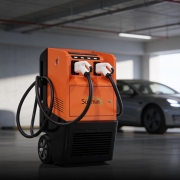
Next-Gen EV Charging Solutions: Full-Stack Hardware, Software, and Microgrid Integration for Global Operators
Deploy a scalable, compliant, and highly profitable EV charging network anywhere in the world with our end-to-end infrastructure ecosystem. We deliver premium hardware seamlessly integrated with advanced cloud management software and cutting-edge microgrid control, unlocking maximum ROI for multi-investor projects and commercial hubs.
一、Why Choose Our Full-Stack EV Infrastructure?
Building a global EV charging network requires more than just plug-and-play hardware. It demands cross-border payment integration, real-time energy management, and extreme localized flexibility.
Our microservices-based architecture offers a complete, future-proof solution across three core pillars:
- Advanced Hardware & Controls:High-performance chargers built with premium components (Schneider, ABB) coupled with standalone smart load controllers.
- Megi Cloud Platform:A modular, white-label backend supporting multi-currency billing, multi-language UI, and sophisticated tiered-pricing logic.
Microgrid Synergy: Native coordination across solar PV, Battery Energy Storage Systems (BESS), and localized grids to minimize operational costs.
二、Key Capabilities & Platform Differentiators
1. Complete Software Customization
Driven by our specialized internal teams—the Megi Cloud Platform Team, Charging Management Platform Team, and Embedded Software Development Team—we offer tailor-made software modifications for localized markets:
- Feature Expansion:Native support for left-to-right (LTR) and right-to-left (RTL) layouts, time-of-use (ToU) pricing, and fleet operations.
- HMI UI/UX Personalization:Customize brand colors, interaction paths, and voice prompts directly on the charger screen or through regional companion apps.
- Roaming Interoperability:Seamlessly link your chargers to top-tier global mapping services (Google Maps, Here Maps) and government compliance portals.
2. Global Ecosystem & OCPP Compliance
Eliminate hardware lock-in and simplify ecosystem integrations. Our systems are fully compatible with international standards:
- OCPP 1.6J / 2.0.1 Support:Complete access to remote start/stop commands, real-time diagnostics, metering data uploads, and firmware-over-the-air (FOTA) upgrades.
- Third-Party Device Access:Bring existing third-party OCPP chargers into our platform with a fast 4-to-8-week custom development cycle.
- Cross-Network Roaming:Direct compatibility with major global networks like ChargePoint, EVgo, and Ionity, alongside native support for Apple Pay, Google Pay, and localized digital wallets.
3. Smart Microgrid Control & Load Management
Avoid expensive utility transformer upgrades. Our standalone Ordered Charging Terminal serves as an intelligent local control center for industrial and commercial parks:
- Overload Prevention:Real-time transformer sampling (≤1 S) dynamically throttles charger outputs to prevent site overloads while keeping error margins below ≤5%.
- Flexible Energy Scheduling:Connect solar PV inverters, BESS, and backup generators to balance “source-grid-load-storage” assets automatically.
- Dynamic Peak Shaving:Program the terminal to prioritize VIP fleet vehicles or curtail secondary commercial building loads (HVAC, advertising screens) during peak utility hours.
4. Enterprise White-Label & Global Compliance
Launch your own regional or global brand using our turnkey white-label capabilities:
- Hardware Rebranding:Custom logos, customized packaging, and multilingual labels (English, Arabic, Spanish, and more).
- App Store Publishing:Reskin the Megi Cloud or LüdianTu user interfaces and publish mobile apps directly under your own Google Play and Apple App Store developer accounts.
- Data Security & Safety:Full compliance with strict regulations like GDPR and PIPL. Chargers carry CE, UL, CB, and KC certifications, operating reliably in extreme conditions from -40 to +70℃ (IP54/IP65).
5. Multi-Investor Revenue-Sharing System
Manage complex financial partnerships effortlessly. Our built-in revenue engine automates profit splitting based on:
- Initial investment ratios
- Total kilowatt-hours (kWh) delivered
- Charging session duration
- Bonus:Export audit-ready financial reports (income, costs, cash flow) directly to Excel or PDF for your stakeholders.
三、Comprehensive Technical & Service Specifications
| Feature Category | Technical Specifications & Capabilities |
| OCPP Protocols | OCPP 1.6J / OCPP 2.0.1 (FOTA, remote start/stop, smart billing) |
| Microgrid Controls | Transformer sampling≤1 s, power control error≤5% via RS485/Ethernet |
| Environmental Performance | Rated for -40℃ to +70℃ IP54 & IP65 enclosure protection |
| Certifications | CE, UL, CB, KC (incorporating Schneider & ABB components) |
| User Authentication | Plug-and-charge, VIN recognition, mobile app, or RFID card |
| Facility Integration | Open APIs for License Plate Recognition (LPR), smart locks, and fire safety systems |
四、End-to-End Lifecycle Services
We don’t just sell technology—we build long-term commercial partnerships. Every deployment is backed by our proactive global engineering support:
- Rapid Proposals:A dedicated project team will answer your inquiry within 24 hours and supply a custom, multilingual proposal within 48 hours.
- Testing Sandbox:Validate your billing rules, revenue-sharing models, and dynamic power distribution strategies in a secure, isolated sandbox environment.
- On-Site Joint Debugging:Our field engineers can be deployed directly to your project sites globally to oversee installation and commissioning.
- Continuous Optimization:Free multilingual training courses covering platform management and hardware maintenance alongside scheduled firmware lifecycles.
Ready to Scale Your Global Charging Network?
Partner with an industry leader in smart EV infrastructure. Contact our engineering team today to review your project blueprints, request a platform demo, or set up your sandbox testing account.
Let’s discuss how we can customize our hardware, software, and microgrid solutions to match your exact regional market needs. Please tell us your expected site location, the number of chargers needed, and whether you require solar/storage integration.