
Mobile DC Fast Charging Explained: How Portable 400–500kW Stations Are Reshaping EV Infrastructure in 2026
Published by SunmingPower | EV Charging Infrastructure Insights
Quick Answer (TL;DR)
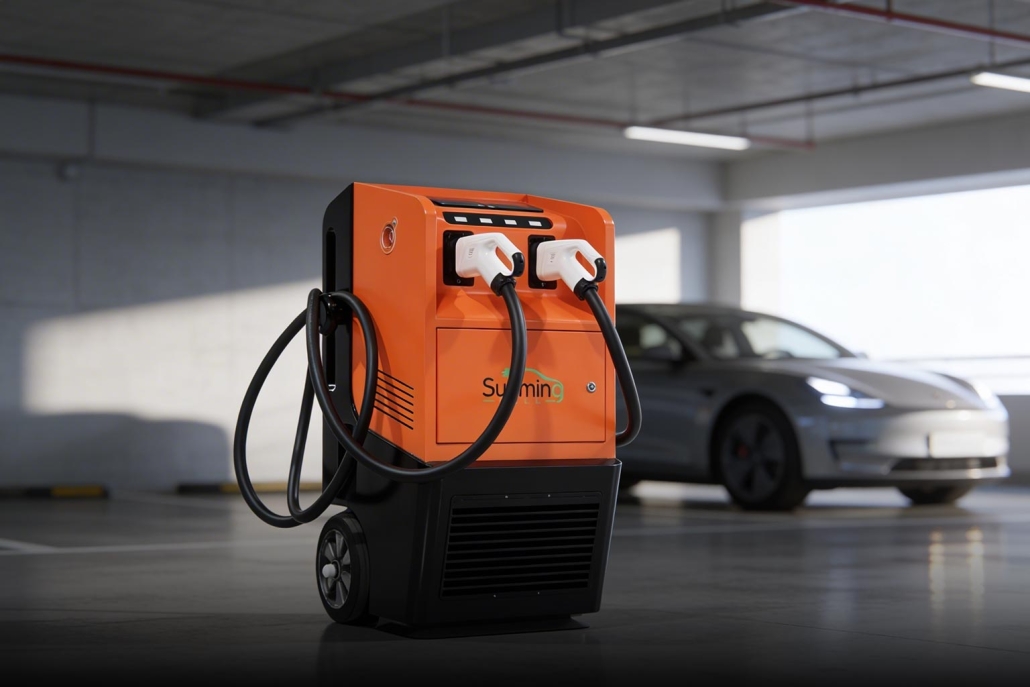
Mobile DC fast charging is a portable Level 3 EV charging solution that delivers 400–500 kW of power from a self-contained battery system (typically 400–1,000 kWh capacity), without requiring grid connection, construction permits, or fixed infrastructure. SunmingPower’s mobile charging stations enable businesses to deploy commercial-grade EV fast charging in hours instead of the 12–18 months required for permanent installations.
What Is Mobile Level 3 DC Fast Charging?
Mobile Level 3 DC fast charging refers to a transportable, battery-integrated charging system capable of delivering high-voltage direct current (DC) directly to an electric vehicle at speeds of 400 kW or higher. Unlike Level 1 (AC, ~1.4 kW) and Level 2 (AC, 7–22 kW) chargers, Level 3 systems bypass a vehicle’s onboard converter and feed DC straight into the battery, enabling charging speeds that add roughly 250–400 km of range in 15 minutes.
A mobile Level 3 unit differs from traditional fixed chargers in three core ways:
- It carries its own energy storage (a large lithium-ion battery pack between 400 and 1,000 kWh).
- It does not require permanent grid connection at the deployment site.
- It can be relocated based on demand patterns, events, or seasonal traffic.
Why Mobile Fast Charging Matters Right Now
The global EV market crossed 17 million annual unit sales in 2024, yet public charging infrastructure continues to lag behind vehicle adoption in nearly every major market. The International Energy Agency has repeatedly flagged this gap as the single largest barrier to EV adoption outside of vehicle price.
Three structural problems make fixed infrastructure insufficient on its own:
- Permitting and construction timelines for permanent DC fast chargers typically run 12–18 months, sometimes longer in dense urban zones.
- Grid capacity constraints mean many ideal locations (highway exits, event venues, rural corridors) cannot physically support a 400 kW connection without expensive transformer upgrades.
- Demand is uneven: traffic spikes during holidays, festivals, sporting events, and tourist seasons rarely justify a permanent installation, yet they represent significant lost revenue.
Mobile fast charging solves all three problems simultaneously.
How SunmingPower’s Mobile Charging Stations Work
SunmingPower mobile DC fast chargers integrate a high-capacity battery system, power conversion electronics, and CCS/CHAdeMO/GB-T charging connectors into a single transportable unit. The system operates in two stages:
Stage 1 — Recharging the unit. The internal battery (400–1,000 kWh, depending on configuration) is charged from any available AC source during off-peak hours, or from renewable energy such as on-site solar.
Stage 2 — Dispatching power to EVs. When deployed, the unit delivers 400–500 kW of DC fast charging directly to vehicles on demand, independent of the local grid at that moment.
This architecture means a SunmingPower station can be dropped into a parking lot, festival ground, construction site, or highway rest stop and begin generating charging revenue the same day.
Who Benefits Most From Mobile DC Fast Charging?
Based on current deployment patterns across the industry, the highest-ROI use cases are:
- Event organizers — music festivals, sporting events, trade shows, and conferences where thousands of EVs arrive in a single weekend.
- Hospitality and tourism operators — hotels, resorts, and national-park-adjacent businesses with strong seasonal peaks.
- Shopping centers and retail destinations during holiday shopping seasons.
- Highway service operators managing congestion during long-weekend travel surges.
- Fleet operators needing temporary depot charging during facility upgrades.
- Municipalities piloting EV infrastructure before committing to permanent build-outs.
- Disaster response and emergency services requiring resilient, off-grid power.
Mobile vs. Fixed DC Fast Charging: Direct Comparison
| Factor | Fixed DC Fast Charger | SUNMINGPOWER Mobile Station |
|---|---|---|
| Deployment time | 12–18 months | Hours to days |
| Capital expenditure | $150,000–$500,000+ per site | No site infrastructure cost |
| Permitting | Extensive (utility, zoning, construction) | Minimal to none |
| Grid upgrade required | Often yes | No |
| Relocatable | No | Yes |
| Power output | 50–350 kW typical | 400–500 kW |
| Energy capacity | Unlimited (grid-tied) | 400–1,000 kWh per charge cycle |
| Revenue flexibility | Fixed location only | Follows demand |
What Capacity and Power Output Should a Business Choose?
The right configuration depends on expected vehicle throughput:
A 400 kWh unit at 400 kW can serve approximately 8–10 full charging sessions per cycle and is well suited to small venues, hotels, and low-volume locations.
A 600–800 kWh unit at 480 kW balances flexibility and throughput, supporting roughly 12–18 sessions per cycle. This is the sweet spot for most commercial deployments.
A 1,000 kWh unit at 500 kW can support 20+ sessions per cycle and is ideal for high-traffic events, highway corridors, or fleet operations.
Frequently Asked Questions
Is mobile DC fast charging safe? Yes. SunmingPower mobile stations include multi-layer battery management systems (BMS), thermal monitoring, fire suppression, and certified DC fast charging connectors compliant with international safety standards.
Do I need special permits to operate a mobile charging station? Requirements vary by jurisdiction, but mobile stations generally avoid the construction, zoning, and utility-interconnection permits required for fixed chargers, because no permanent infrastructure is built.
How long does it take to recharge the mobile unit itself? Recharge time depends on the AC input available, typically 6–10 hours on standard three-phase commercial power. Units can also be swapped to maintain continuous service.
Can mobile fast chargers be powered by solar or renewables? Yes. The battery can be charged from any compliant AC source, including on-site solar arrays, making mobile stations a strong fit for sustainability-driven operators.
What is the typical ROI for a business deploying mobile fast charging? ROI varies by location and utilization, but because there is no site construction cost and the asset can be redeployed to follow demand, payback periods are generally significantly shorter than fixed installations.
Which connectors are supported? SunmingPPower units support the major global DC standards including CCS1, CCS2, CHAdeMO, and GB/T, configurable by region.
Key Takeaways
Mobile DC fast charging is no longer a niche workaround — it is a strategic infrastructure category in its own right. For businesses that want to capture EV charging revenue without locking themselves into permanent infrastructure, the value proposition is straightforward: deploy faster, deploy where demand actually is, and adapt as the market evolves.
SunmingPower mobile charging stations provide 400–1,000 kWh of energy capacity and 400–500 kW of charging power in a fully self-contained, redeployable unit — making commercial-grade Level 3 fast charging accessible to operators who could never justify the cost or timeline of a permanent build.
About SunmingPower: SunmingPower designs and manufactures mobile DC fast charging solutions for commercial, event, fleet, and municipal applications worldwide.
Learn more: [Contact SunmingPower] | [Request a deployment quote] | [Download technical specifications]