
Mobile EV Charging Without Major Grid Upgrades: How Solar + Battery Storage Systems Are Closing the EV Infrastructure Gap
The EV Charging Bottleneck Is No Longer Vehicle Supply — It’s Power Infrastructure
Global EV adoption is accelerating at a pace that traditional utility infrastructure was never designed to support. According to the International Energy Agency, worldwide electric vehicle sales exceeded 17 million units in 2024, while commercial fleet electrification continues to expand across logistics, construction, mining, ports, and industrial transportation sectors.
However, one critical issue is slowing deployment:
High-power EV charging infrastructure is not keeping up with energy demand.
In many operational environments — including remote construction projects, temporary industrial sites, logistics depots, mining operations, ports, and disaster-response zones — utility grids often cannot provide sufficient power capacity for DC fast charging.
Today’s infrastructure gap is primarily driven by three factors:
- Limited transformer and utility capacity, often requiring costly grid upgrades with lead times ranging from 12 to 36 months
- Lack of reliable grid access in off-grid or temporary operating environments
- High peak-demand electricity charges that significantly increase charging operating costs for fleet operators
As a result, more companies are turning toward mobile photovoltaic energy storage charging systems as a faster and more flexible alternative to conventional charging infrastructure.
What Is a Mobile Photovoltaic Energy Storage Charging System?
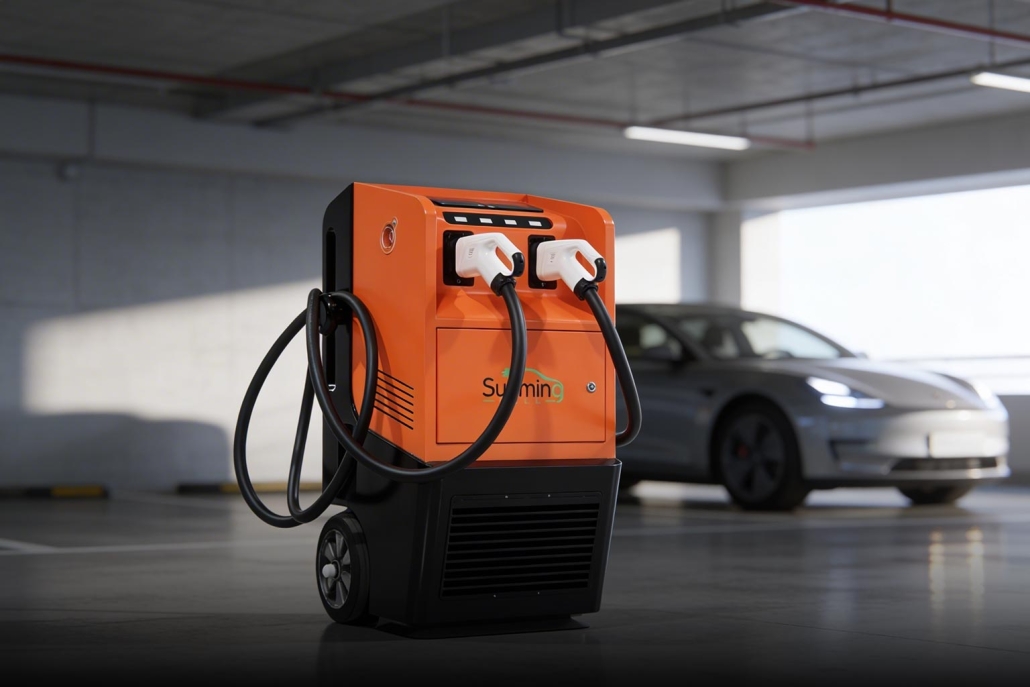
A mobile photovoltaic energy storage charging system — also referred to as a mobile BESS (Battery Energy Storage System) or mobile microgrid EV charger — is an integrated clean-energy platform designed to deliver high-power EV charging without relying entirely on the utility grid.
These systems typically combine:
- High-capacity LiFePO4 battery storage
- Solar photovoltaic (PV) integration
- DC fast-charging capability
- Intelligent energy management software
- Integrated thermal control systems for cooling and heating
- Peak shaving and microgrid support functions
Unlike traditional fixed charging stations, mobile charging platforms can be transported directly to the point of demand and deployed rapidly. They function simultaneously as:
- EV charging infrastructure
- Distributed energy resources (DERs)
- Temporary microgrids
- Emergency backup power systems
This flexibility makes them especially valuable in industries where operations move faster than grid expansion timelines.
Key Advantages of Mobile Solar Energy Storage EV Charging
1. Rapid Deployment
Traditional grid-connected DC charging stations often require permitting, utility coordination, transformer upgrades, and civil construction that can take years.
By comparison, containerized mobile charging systems can typically be operational within hours after arriving onsite.
2. Grid-Independent Charging
Mobile photovoltaic charging systems can operate in locations with:
- Weak grid connections
- No utility access
- Temporary infrastructure
- Disaster-related outages
This enables electrification projects to move forward immediately instead of waiting for permanent utility expansion.
3. Peak Demand Reduction
Battery storage systems can charge during off-peak periods or through solar generation, then discharge energy during charging sessions.
This reduces expensive utility demand charges and improves energy cost efficiency for fleet operators.
4. Renewable Energy Integration
By integrating solar PV with battery storage, operators can reduce carbon emissions while improving energy resilience and sustainability performance.
Sunming Power’s Featured Solutions
208kWh / 180kW Fixed Solar Energy Storage Charging System
This semi-permanent charging solution is designed for locations where long-term charging demand exists but utility upgrades are impractical or delayed.
Typical applications include:
- Construction equipment charging
- Agricultural operations
- Rural fleet depots
- Industrial equipment yards
- Remote service facilities
Core specifications include:
- 208 kWh LiFePO4 battery storage
- 180 kW DC fast charging
- Integrated liquid-cooling thermal management
- Cold-weather heating capability
- Solar PV compatibility
The system supports charging for commercial EVs, electric construction machinery, and heavy-duty industrial vehicles.
1.2MWh / 2MWh Mobile Fast Charging Platform
This is Sunming Power’s flagship mobile solution — a fully containerized, transportable charging platform capable of serving multiple EVs simultaneously.
These containerized systems are engineered for:
- Logistics fleet electrification
- Mining operations
- Port terminals
- Temporary public charging deployment
- Emergency power response
- Industrial microgrids
Key capabilities include:
- Up to 2MWh battery capacity
- Up to 650kW ultra-fast DC charging
- Simultaneous multi-vehicle charging
- Peak shaving and demand-response functionality
- Microgrid islanding support
- Transportable modular deployment
This architecture enables megawatt-class charging even in locations with minimal or nonexistent utility infrastructure.
How Mobile Battery Energy Storage EV Charging Works
The operating model is straightforward but highly effective.
Step 1: Energy Collection
Energy is collected either from:
- Solar photovoltaic arrays
- Off-peak utility charging
- Hybrid renewable energy sources
Step 2: Battery Energy Storage
The onboard LiFePO4 battery system stores energy until charging demand occurs.
Step 3: High-Power EV Charging
When EVs connect, stored energy is discharged at high-speed DC charging rates independent of immediate grid availability.
Step 4: Grid Optimization
When connected to utility infrastructure, the system can stabilize local power demand through:
- Peak shaving
- Load balancing
- Demand-response participation
- Backup power support
This hybrid approach dramatically reduces infrastructure constraints for commercial EV deployment.
Where Mobile EV Charging Systems Deliver the Highest ROI
Construction & Infrastructure Projects
Electric excavators, loaders, dump trucks, and site vehicles require high daily energy throughput in locations where grid access is often unavailable.
Mobile charging systems eliminate dependence on diesel fuel logistics while enabling low-emission jobsite operations.
Fleet Electrification
Fleet operators frequently face long delays waiting for transformer upgrades and utility approvals.
Mobile BESS charging systems allow fleets to begin operating immediately while permanent charging infrastructure is developed.
Mining & Remote Industrial Sites
Mining projects, energy infrastructure projects, and remote industrial facilities benefit from clean, transportable power systems that avoid costly permanent grid expansion.
Emergency Response & Disaster Recovery
During grid failures or natural disasters, mobile energy storage systems can rapidly supply power for:
- Emergency EV charging
- Critical infrastructure
- First responder fleets
- Temporary microgrids
Temporary Events & Pop-Up Charging
Festivals, motorsports, expos, and temporary transportation hubs often require large amounts of short-term charging capacity without permanent infrastructure investment.
Why LiFePO4 Batteries Are Preferred for Commercial Energy Storage
Most commercial mobile charging platforms now rely on lithium iron phosphate (LiFePO4) chemistry rather than nickel-based alternatives.
The advantages are significant:
- Higher thermal stability and improved safety
- Lower risk of thermal runaway
- Longer operational lifespan
- Typically 6,000+ charge cycles
- Lower total cost of ownership
- Cobalt-free battery chemistry
- Strong performance under frequent daily cycling
For demanding commercial charging applications, LiFePO4 has become the preferred battery technology standard.
Mobile BESS Systems Are Becoming Critical Distributed Energy Resources
Modern mobile energy storage charging platforms do far more than charge EVs.
They also function as distributed energy resources capable of improving overall energy resilience.
Operators can use these systems to:
- Reduce peak electricity demand charges
- Support renewable energy integration
- Participate in utility demand-response programs
- Provide backup power during outages
- Improve ESG and Scope 2 emissions performance
- Stabilize weak local grids
This transforms EV charging infrastructure from a pure operational expense into a strategic energy asset.
Frequently Asked Questions
Can a mobile battery storage system charge heavy-duty electric trucks?
Yes. High-capacity mobile charging platforms can support Class 8 electric trucks and other heavy-duty commercial vehicles, depending on battery size, duty cycles, and deployment strategy.
How are mobile EV charging systems recharged?
Systems can recharge through:
- Solar PV generation
- Utility grid charging during off-peak hours
- Hybrid renewable energy systems
- Centralized charging hubs
How quickly can deployment occur?
Most containerized systems can be deployed and operational within several hours, compared to months or years for traditional fixed infrastructure projects.
Is mobile charging more expensive than grid-connected charging?
Per-kWh charging costs may be slightly higher in some scenarios. However, avoided utility upgrades, reduced demand charges, faster deployment timelines, and improved operational flexibility often lower total ownership costs.
What is the expected service life?
With proper thermal management and LiFePO4 battery chemistry, commercial systems are commonly designed for 10–15 years of operational service.
The Future of EV Infrastructure Is Flexible, Mobile, and Distributed
Permanent charging infrastructure will remain important, but utility expansion alone cannot support the speed of global fleet electrification.
The next phase of EV charging growth will increasingly depend on:
- Mobile energy storage systems
- Distributed charging infrastructure
- Solar-integrated microgrids
- Modular off-grid charging solutions
For industries operating in remote, temporary, or power-constrained environments, mobile photovoltaic energy storage charging systems provide a practical path toward scalable electrification without waiting years for grid upgrades.
As EV adoption continues to accelerate worldwide, flexible energy infrastructure will become just as important as the vehicles themselves.
Sunming Power’s mobile and fixed photovoltaic energy storage charging systems are built for that future: zero-emission, grid-independent, and ready to power the electrification revolution anywhere on the map.
About Sunming Power
Sunming Power designs and manufactures mobile and fixed photovoltaic energy storage and EV charging systems for fleet operators, construction firms, industrial sites, and emergency response applications worldwide. Our solutions combine LiFePO4 battery technology, integrated thermal management, and intelligent energy management software to deliver clean, reliable, ultra-fast charging — with or without grid access.
📩 Contact us to discuss your off-grid charging, fleet electrification, or mobile microgrid project.